Cultural Highlights of the Caucasus



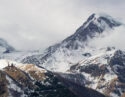
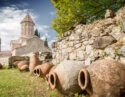


Travel across diverse and inspiring landscapes with this luxury Caucasus itinerary, journeying through Azerbaijan, Georgia and Armenia over 14 unforgettable days. Discover how the region's location, at the crossroads of the ancient Silk Road, shaped its culture and cuisine. Taste Georgian wines perfected in clay qvevri pots, see futuristic architecture, hilltop monasteries and buildings hewn from pink volcanic tuff – all set against the Caucasus Mountains that spine the region.
Trip highlights
- Browse intricate carpets, silks and spices in Baku’s bazaars
- Hike to waterfalls and through gorges in Kazbegi National Park
- Enjoy a private wine tasting of Georgia’s natural and qvevri-aged wines
- View Tbilisi’s architecture from mountaintop Mtatsminda Park
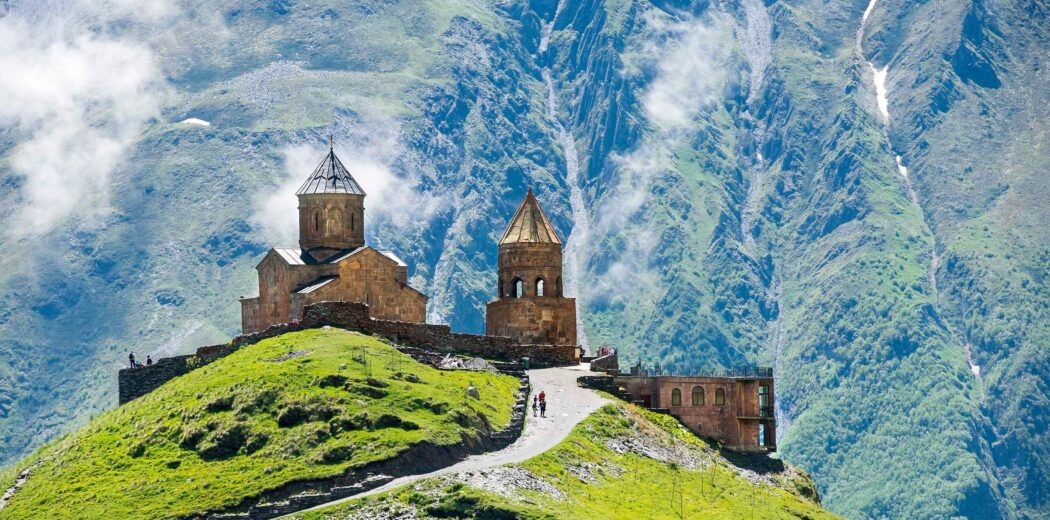
- Visit Armenian monasteries backed by dramatic mountain peaks
- See the rose-tinted buildings on a guided tour of Armenia’s ‘Pink City’


Our bespoke trips include
We design one-of-a-kind journeys incorporating luxury in all its forms. Our bespoke trips include:
- Luxury accommodation throughout
- Privately guided tours
- Private transfers
- Meticulously selected experiences
- Expertise and support from your Jacada Concierge

Itinerary in detail
Days 1–4
Explore past and present in Baku
Once a crucial trading hub on the Silk Road route, Azerbaijan’s capital curls around the Caspian Sea. Baku is a beguiling blend of medieval history and modern architecture. The city is best explored on foot. Dive into bazaars selling perfumes and intricately woven carpets in the shadows of futuristic buildings like Flame Towers, a trio of skyscrapers.
Its historic walled city, Icherisheher, is dominated by the Palace of the Shirvanshahs, built between the 12th and 15th centuries. You’ll spend time unlocking the history of its mosques, tombs and palatial bath house with a private guide. Wander the narrow passageways, passing limestone buildings and homes with wooden balconies.
A must visit during your stay is the Maiden Tower, thought to date to the sixth century BC. This defining symbol of the city houses a small museum and is topped by a platform for views out to sea.

Where you could stay


Go deeper
Culinary tour
City tour
Pottery masterclass

Get a taste of local food and wine
Azerbaijani cuisine brings together Persian, Turkish and Eastern European influences. Discover national and local specialities on a tasting tour through Baku. Accompanied by an expert guide, start in a café to try local wines paired with snacks. Try qutab, a stuffed flatbread often eaten for breakfast, before finishing with traditional tea and sweets.

Visit Baku’s architectural monuments
Baku is home to some of the most incredible architecture in Azerbaijan. On this immersive tour, you’ll visit the city’s most notable monuments. Your knowledgeable guide will take you to Upland Park – the city’s highest point – and bayside landmarks including flower-shaped Deniz Mall and the curvy Heydar Aliyev Centre, designed by Zaha Hadid.

Create your own ceramic souvenir
The art of pottery in Azerbaijan dates back to the Bronze Age. During this hands-on experience, you’ll be guided through the skills of pottery by a master of the craft. Learn about the properties of clay, and how to manipulate it, and take a turn on the potter’s wheel. You can choose to make a vase, pot or plate. You’ll then learn how to decorate your creation, which you can take home as a unique souvenir.
Days 4–6
Get to know historic Tbilisi
Your journey heads northwest to Georgia, where you’ll spend a few days exploring the capital, Tbilisi. At its heart is Old Tbilisi, the historic centre, whose cobblestoned lanes meander down from hilltop Narikala, a reconstructed fourth-century fortress.
During bespoke, in-depth tours, you’ll unlock stories of the city’s culture and heritage. See historic buildings and monuments in granular detail. And meet local artists to learn more about the dynamic creative scene.
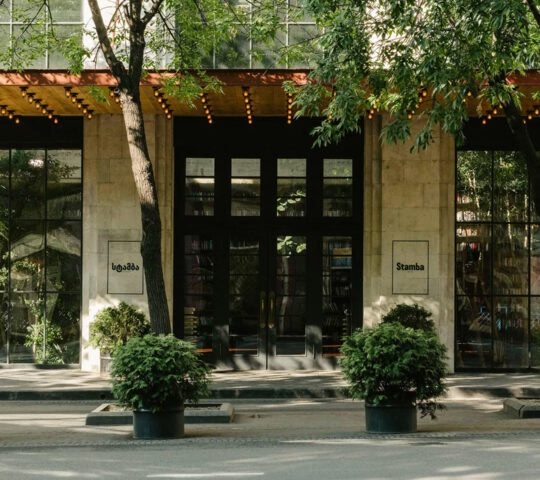
The city is a hub of Georgia’s culinary scene, with influences from Europe and Asia. Visit cafes or food stalls to try khachapuri, a bread filled with egg and cheese. Taste natural wines at Warehouse, a wine shop in the landmark Stamba Hotel, and enjoy specialities like khinkali (soup dumplings) and grilled meats or mtsvadi.

Where you could stay
Meet local artists in their home

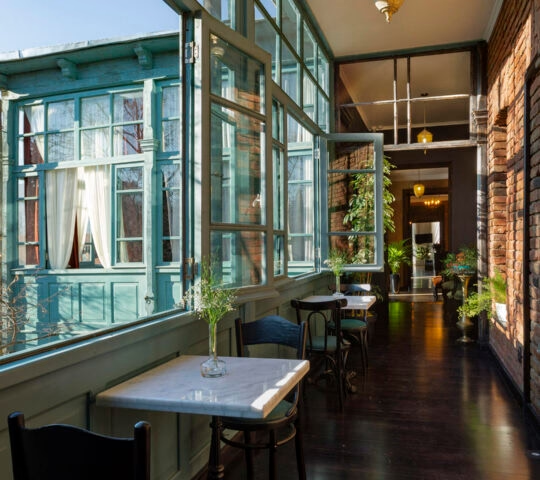
Get to know Tbilisi’s creative scene with an engaging art and culture tour. Start at the Flea Market, an open-air bazaar stuffed with vintage silverware, jewellery, maps and vinyl. You’ll then be taken to the private home and gallery of art historian Nino Kipshidze and David Sulakauri, the only artist in the city who paints using the encaustic technique. Tour the studio and chat to the couple as you learn about their work and the 19th-century building, known as the Blue House.
Days 6–8
Take to the trails in Kazbegi National Park
Heading north, you’ll enter Kazbegi National Park – high in the Caucasus Mountains. The air thins and the scenery opens up here, with trails up to peaks and through alpine valleys with meadows, gorges and mineral lakes.
You’ll spend the next few days walking through these inspiring landscapes. Take a guided forest hike to Dariali Gorge and Gvleti Waterfall, passing the ruins of stone monuments and surrounded by mountains. The cascade rushes to a heart-shaped pool known as the ‘lake of love’. Follow trails in the Truso Valley, a dramatic landscape of narrow canyons, abandoned stone villages and rust-red travertine formations.
You’ll also get an authentic taste of local life. Have lunch with a family in the cliffside village of Tsdo. Your host will give you a tour of the area and their house before you help to prepare khinkali, or meat dumplings.

Days 8–10
Go wine tasting in the Kakheti Wine Region
With winemaking traditions dating back millennia, Kakheti is known as the ‘cradle of wine’. Archaeologists have unearthed qvevri – egg-shaped clay vessels in which wine was fermented and stored – dating from the seventh century BC. During your time here, you’ll learn more about the history of this wine region, and visit vineyards and wineries still employing ancient techniques.
The vast majority of Georgia’s wines are produced here, and you’ll have ample opportunities to taste them. Sample speciality natural and amber wines and be guided through perfect food pairings. Visit pretty villages and towns surrounded by the vineyards of the Alazani Valley and descend into cellars for exclusive tours, tasting wine straight from the qvevri.

Where you could stay
Drink it in
Cellar tour
Natural wines
Heritage museum

Visit a traditional wine cellar in Sighnaghi
Pretty Sighnaghi has winding cobbled lanes, views across the Alazani Valley and centuries of winemaking heritage. Accompanied by a knowledgeable guide, discover the town’s role in the region’s viticulture, including a visit to a cellar with qvevri pots. After the tour, enjoy a wine tasting with traditional snacks and local cheeses.

Dine with local wines at Pheasant’s Tears winery
Pheasant’s Tears is among a growing number of wineries focused on reviving ancient winemaking techniques and heritage grapes. One of the country’s most prolific producers of natural wines, it also has a renowned farm-to-fork restaurant. Dine on dishes driven by local, seasonal produce and expertly paired with wines.

Tour a vintage wine cellar and museum
The landscaped, bloom-filled gardens of Tsinandali Estate, where Georgian wines were first bottled, are home to a small museum founded by Prince Alexander Chavchavadze in the 19th century. See period furniture, clothing and art before touring a wine cellar with more than 15,000 bottles, including one from 1814.
Days 10–11
Explore more of Tbilisi
On a stopover in Tbilisi, you’ll have free time to wander. Ride the funicular railway to mountaintop Mtatsminda Park, the highest point. Its amusement park has carousels and a Ferris wheel with views across the city.
On Rustveli Avenue, Tbilisi’s main thoroughfare, architectural highlights include the Parliament of Georgia, Opera House and Kashveti Church. Browse galleries and souvenir stores, and stop in cafés in tree-filled squares.
In Old Tbilisi, see Kartlis Deda or ‘Mother of Georgia’, an imposing aluminium statue of a woman in traditional dress, and walk around the red-brick domes of 17th-century bathhouses, delving beneath to soak in the sulphur springs.

Where you could stay
Days 11–12
Monasteries and heritage makers in Dilijan
Your Caucasus route dips south to Dilijan. The mountain town, in northern Armenia, lies within Dilijan National Park. Its evergreen forests, meadows and gorges have earned the area the nickname ‘Little Switzerland’. Famed for spa resorts, it makes a luxurious base for exploring the verdant surroundings and nearby monasteries.
It’s also a hub of traditional Armenian crafts, with a rich heritage of carpet weaving, pottery, jewellery making and intricate woodwork. Visit the Old Dilijan Complex, a reconstructed 19th-century quarter with artisan workshops. You can see masters at work and browse pieces to take home, or take a hands-on workshop.


Discover more
Honey tour
Armenian art
Haghpat Monastery

Learn about the region’s beekeeping traditions
Alaverdi Honey Farm and Meadery has more than 150 beehives. Tour the farm, set in the mountains in the town of Alaverdi, and learn about beekeeping and honey harvesting methods. You’ll also have the chance to taste honey and mead produced here, and perhaps buy some to take home.

Visit a gallery celebrating regional and European art
Over three storeys, Dilijan Art Gallery spans several centuries and houses works by some of Armenia’s most important artists. Original paintings by Hovhannes Aivazovsky and Edgar hang on the walls alongside pieces by Jean Carzou. You’ll also find regional carpets and pottery.

Explore a Byzantine monastery complex
A UNESCO World Heritage Site, hilltop Haghpat Monastery was an important centre for science and learning. You’ll tour the 10th-century monument’s chapel tombs and khachkars (carved stone crosses) and learn about its architecture, blending ecclesiastical and vernacular styles.
Days 12–14
Explore Armenia’s ‘Pink City’
Armenia’s capital, Yerevan, was founded in the eighth century BC – and its layered, complex history is tangible in its ancient artifacts and Soviet-era architecture. Republic Square is the heart of the city, with neoclassical government buildings and musical fountains. Here, the History Museum has fascinating archaeological finds including a shoe dated to the fourth century BC.
Many buildings were constructed with locally sourced volcanic tuff stone, whose rosy tint earned the city its nickname of ‘Pink City’. The mountainous surroundings and, most notably, the twin peaks of dormant volcano Mount Ararat add to the city’s famous beauty.
Over the final few days of your adventure, scale the Yerevan Cascade. This limestone staircase connects the city centre and Monument district, sweeping past gardens, public artworks and fountains. Delve into learnings of the past at the Matenadaran library, home to ancient Greek and Armenian manuscripts. Stop in a café or bakery to try a slice of paklava, a nutty, lemon-laced variation of the layered pastry dessert baklava.

Where you could stay


Make it mine
Khor Virap
City tour
Lavash making

Visit the birthplace of Armenian Christianity
Surrounded by green valleys and backed by Mount Ararat, Khor Virap Monastery is worth visiting for the setting alone. It also played a significant role in Armenia’s adoption of Christianity. Gregory the Illuminator was imprisoned here for his faith. You’ll also visit Echmiadzin Cathedral. Often regarded as the oldest cathedral in the world, it was built in 301AD when Armenia adopted Christianity as its official religion.

Explore Yerevan’s art and architecture
On an in-depth tour of the city, you’ll visit architectural highlights and hear how Yerevan’s history has shaped its skyline. Much of the city was designed by Alexander Tamanyan in the 1920s, during the Soviet era. Spend time in Republic Square, City Park and Abovyan Street, lined with 19th-century buildings, then browse contemporary artworks at Gafeschian Centre of Art.

Take a baking masterclass to make Armenian flatbread
Lavash is one of several Armenian creations included in UNESCO’s Intangible Cultural Heritage List. During this hands-on class, you’ll learn the secrets of making the flatbread, while hearing more about its heritage and place in the country’s culinary fabric. You’ll also try jengyalov hac, a flatbread stuffed with more than 20 varieties of chopped herbs and greens.
We had a wonderful trip in Georgia with diverse experiences and activities that suited us. The reasons are clear. First, we had an excellent pre-trip planning process with Jack Beckford where we were able to iterate through places and itineraries that made sense. Second, the logistics on the ground were impeccable, from our personal tour guide to our driver and…
Why book with Jacada

Personalised design
We’ll plan your trip around your personal interests, tastes and preferences, providing honest advice based on first-hand knowledge.

Authentic experiences
Our expert guides and brilliant Concierges are hand-picked for their ability to bring your destination to life with care and passion.

Positive Impact
We seek out unforgettable experiences that benefit both local communities and the environment.